
During the deep cold of winter I think about our wildlife. How do they cope?
I often think of bears, in particular. I think of bears out there, in their dens - quiet and still. Waiting out winter.
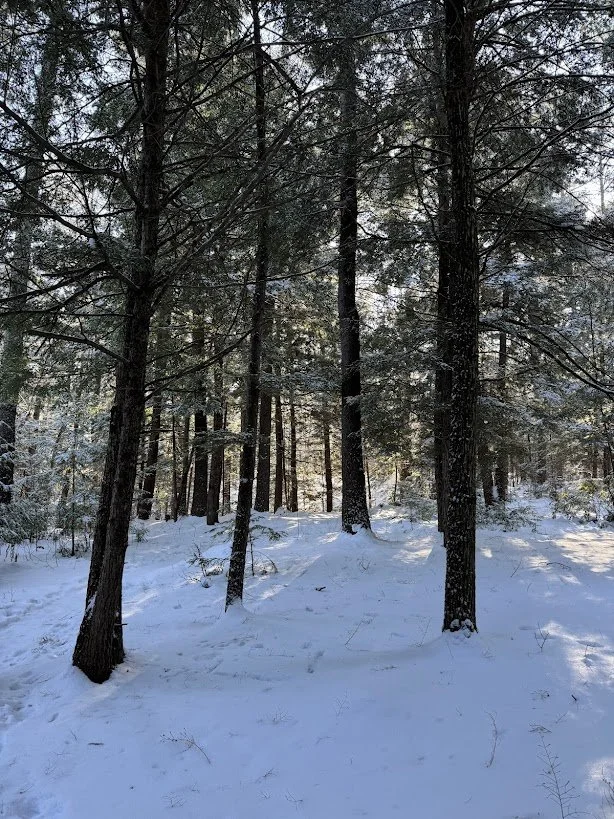
The way the sun hits the snow this time of year, the sound of the snowpack crunching under my weight, the steely smell and the sensation of the icy air as I breathe it in - it all reminds me of my days visiting bear dens.
For several winters in the 90s and 2000s, I worked with other bear biologists doing "den work" to collect reproductive and survival data for state wildlife agencies and research institutions (here in Maine, as well as in New Mexico and Tennessee).
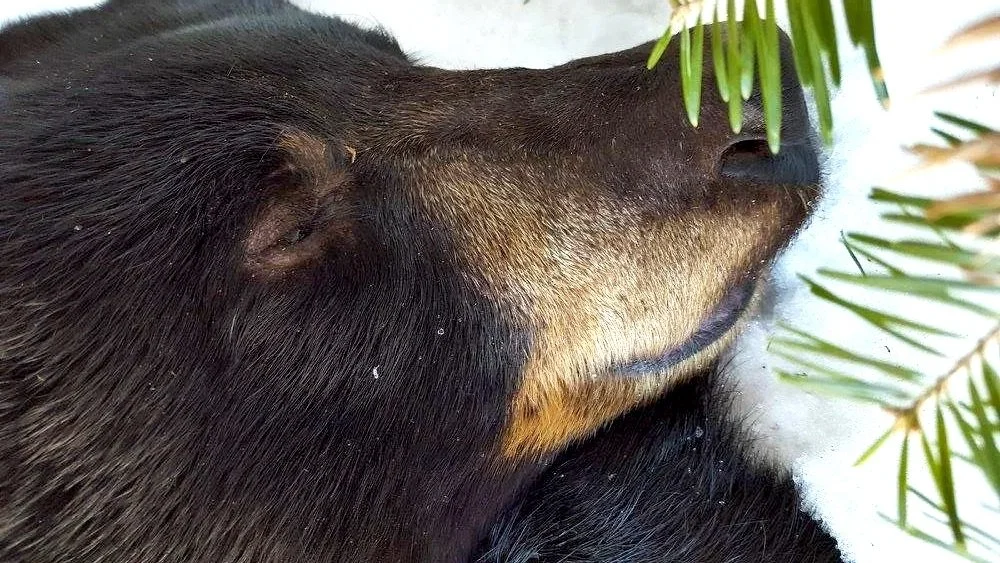
A female black bear at her den in northern Maine (photo: Iain Stenhouse). My family and I were visiting this den as guests of the field crew of the Maine Black Bear Study in 2016. I had handled this bear as a 2 year-old in 1999, and again as a 4 year-old in 2001 when I was on the den crew. Seeing “Spunky” again at 19 years old — with her three healthy cubs — with my husband and young daughter in tow, was the joy of a lifetime!
Over the course of my years working on various bear studies I learned a lot about why and how bears go into a dormant state during the winter. Here are just a few fascinating facts to ponder.
Bears don't hibernate* because it's cold and dark. Bears hibernate* because food is lacking. A black bear's diet is up to 85% plant-based, and their grocery store shelves are pretty empty right now.
“A black bear’s diet is up to 85% plant-based, and their grocery store shelves are pretty empty right now.”
Bears spend most of the year preparing for winter. They build up fat reserves when food is abundant, and then den up. They make their fat reserves last by dramatically reducing their metabolic activity.
For example, a denning bear’s heart rate slows down to just 8 beats per minute (!!), as compared to a regular heart rate of 45-50 bpm.
Here's the fact that truly takes my breath away. Bears reduce their respiration down to one breath every 45 seconds. Hold your breath for 45 seconds...and keep doing that for five months straight!
Bear physiology during hibernation* is so fascinating, that I couldn't possibly do it justice in just one Phenology Note.
*Are bears "true hibernators"? I decided to not go into the technical aspect of "true hibernation" in this note because it's a complicated answer. For many years bears were not considered true hibernators because they do not lower their body temperature as drastically as deep hibernators. Many scientists now believe bears to be “super hibernators”. Or you can call it torpor, but the physiological state of bears in winter is totally unique to bears and bears alone.
subscribe to my newsletter below. You’ll RECEIVE free tips, tools, and insights for building habitat & Hope, as well as advance notice of my signature events!

The Personal Ecologist
I co-create biodiverse habitats with eco-minded stewards throughout the Northeast - at any scale.
I have 30 years of experience and a lifelong commitment to wildlife conservation.
Read My Story.
-
Deborah
Perkins
- Jul 31, 2026 Beautiful Buttonbush in Bloom
- Jul 11, 2026 Baby Bats Need Love Too: How to Benefit Bats in Your Home Habitat
- Jul 2, 2026 How do Bird Eggs Hatch? Mother Nature's "Escape Room"
- Jun 8, 2026 Maine's Real Lupine Revealed
- May 14, 2026 Shadbush in Bloom
- May 12, 2026 Saving Songbirds Starts with Your Morning Coffee
- May 1, 2026 Native Nectar for Queen Bumble Bees
- Apr 25, 2026 Waves of Warblers
- Apr 12, 2026 Bees on Red Maple Flowers
- Mar 23, 2026 How do bears hibernate? Bears in Winter Part 2
- Feb 7, 2026 Why do bears hibernate? Bears in Winter Part 1
- Feb 5, 2026 Plan Your Habitat Garden
- Jan 17, 2026 The True Harbingers of Spring: Chickadees
- Jan 8, 2026 Carnivore Coexistence (Leopold's Wise Words - Part 1)
- Dec 14, 2025 Dead and Dying Trees are Key to Life
- Oct 31, 2025 Hallowed Habitat
- Apr 3, 2025 Give a Warm Welcome to Wild Bees (Super-pollinators Part 2)
- Jan 28, 2025 Beechnuts - Superfood for Bears & Other Wildlife
- Dec 22, 2023 Storm Habitat: Nurse Logs, Dens, and More
- Jun 18, 2023 Bring the Magic of Fireflies Back Home Again
- Jun 17, 2023 Snapping Turtles on the Move
- Mar 20, 2021 The Power of Photoperiod
- Feb 19, 2021 The Golden-crowned Kinglet: A Royally Charming Winter Resident
- Feb 8, 2021 Subnivean Secrets
- Jan 9, 2021 Wild Reads: Ravens in Winter
- Oct 23, 2020 Flower “Beds” for Bumble Bees
- Oct 4, 2020 Wise Oaks, Clever Jays
- Sep 11, 2020 Goldenrods: Top Plants for Boosting Biodiversity
- Aug 25, 2020 Gentle Golden Wasps Adorned with Pollen
- Aug 1, 2020 Water for Wildlife - Birdbath Basics & More
- Jul 19, 2020 Fruits of the Forest
- Jul 11, 2020 Hungry Little Hummingbirds
- May 31, 2020 Wild Geranium in Flower
- May 24, 2020 Moosewood Chandeliers
- Apr 19, 2020 Attracting Bluebirds without Boxes
- Apr 12, 2020 Hungry Bears on the Move
- Mar 27, 2020 Sky Dancing
- Mar 22, 2020 Fox Kits Being Born
- Mar 15, 2020 Corvids a-Courtin’
- Mar 8, 2020 Phenology Notes: Witnessing The Seasons of our Wild World
- Jan 2, 2019 Wild Reads: We Took to The Woods
- Nov 28, 2018 Winterberry: The Gift that Keeps on Giving
- Aug 16, 2018 Where Have All the Whip-poor-wills Gone?
- May 16, 2018 The Wonder of Wild Bees (Super-pollinators Part 1)
- Mar 21, 2018 Wildlife Habitat Design in A Wounded World
- Feb 16, 2018 “Intelligent Tinkering” - How to Boost Biodiversity at Home (Leopold’s Wise Words Part 2)
- Nov 14, 2017 A Top Threat to Biodiversity: Invasive Plants
